In the Cut Leadership Conversation with Tuti Scott
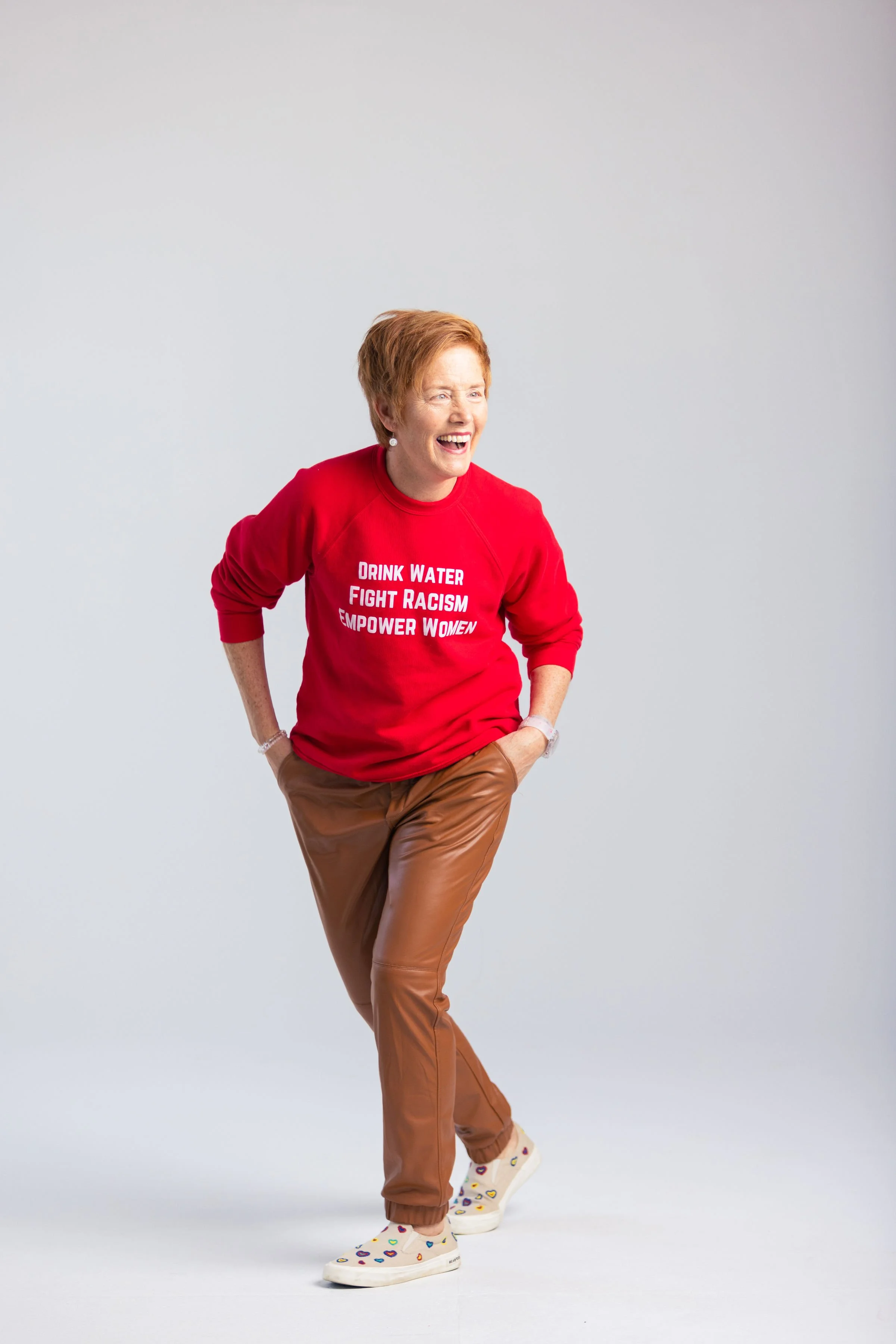
Photo by Ally Schmaling
Born in a rural town and shaped by adversity and resilience, Tuti’s participation in basketball provided her with her first taste of belonging, leadership and achievement. Acknowledging her white privilege, Tuti forged a path of equity for women leading change in companies, nonprofit organizations and in the game of money and power. A lifelong feminist, Tuti’s passion for humanity and the survival of our planet are at the core of what motivates her.
Tuti Scott, one of my favorite redheads, welcome to In the Cut!
Honored to be here with you!
I didn’t come up with this question. I listen to the R.A.C.E podcast and the host asks this question in relation to how race matters when doing the work of DEIJB. How this matters in this conversation is in how you lead informed by your identity. So, I want to start off with all the many ways you choose to define yourself.
I like that you call me a redhead because that is one of them. We are special people. We have a little bit extra fire and it takes more anesthesia to numb us out so that says something about our endurance and pain tolerance. But, yea, I’m a lesbian feminist. I’m a white woman. I jumped class. I used to be in the class of hard knocks and now I’m in the class of elegance and choice.
I’m a basketball point guard. I’m a coach. And I have all of those other ones just showing up as a woman, sister, aunt – I’m a great aunt, actually. Yea, and a friend.
Sheila: We have the great aunt thing in common. How yummy is that?
You said a couple of things that I want to lean into. When and where did feminist enter? When did you get that?
I feel like I was born a feminist. I was in the womb observing my 22-year-old mother who had 4 toddlers under the age of 5 and a husband who didn’t really know he had kids; had some psychotic breaks and was an alcoholic. And I’m in there watching this shit-show that I’m coming into.
I have just been in awe of women who do so much with so little support and have really felt that there should be massive numbers of people wanting to make it easier for moms, working women and women who are trying to express their creativity, and obviously athletes.
And then in 5th grade I didn’t understand how I was breaking gender norms. Why can’t girls play tether ball and play foursquare? What do you mean I can’t be on the science project team? You know all that stuff that was so gendered in the 60s and 70s.
“Why aren’t we celebrating women for the worthiness that we are?”
What does it require of you to be a feminist?
Women and our vaginas make humans and push them out into the world. We’ve all had an intimate relationship with a vagina. So why aren’t we celebrating women for the worthiness that we are. Just being who we are, point blank. To me, everybody should be a feminist.
You know, you have to go back and look at society, media culture and all the internalized misogyny, sexism, the rape culture and all the things that have pushed people away from truly loving women. I’ve been trying to preach that to people since an early age.
Sheila: So, it’s easy for you to be a feminist?
Yea, it just comes naturally. I’m trying to think of an analogy. You know, you just show up for things that matter to you. You fight hard for them. I’ve been befuddled my whole life. Don’t you want women to have agency and autonomy? Isn’t it cool when you see a woman in power? Obviously not; 2 elections where 2 uber competent women didn’t win a national election. We have a ton of work to do and that’s exhausting.
Sheila: And necessary.
Yea, and I haven’t even gotten to women of color and the shitshow that you have to go through. Dealing with all the things. The weathering of Black women is real. It’s beyond a hard time.
Sheila: I did an In the Cut interview with a Black female attorney. She said that one of the things she is working on is being more flexible in her effort to understand why people don’t understand. I asked her if she wanted them to agree? And she said, “No, I just want to understand right now. The first step is I just need help in understanding how and why people think what they think.”
I totally agree. I was moderating a panel at the Smithsonian and I said out into the audience, “Can someone just get me a group of patriarchal princesses? I just want to ask them a lot of questions in a safe space.” I want to understand why they just give it up and what they get out of it.
I get the economic reason since for some women that is their survival. But there’s got to be a lot more women… isn’t it that 45% of heterosexual families where women are the primary breadwinner? There’s a lot of women where economics isn’t the thing.
Sheila: Well, if you recognize that you come out of that fabulous thing called a vagina knowing nothing. Everything that you learn has been given to you by another human. How far up the food chain do you have to go before you can break the train wreck that happens to these poor babies when they are born. “I promise to you that I won’t be a train wreck” should be the first promise to every baby.
You said that you jumped class. The work that you do helped you jump class. What do you do, or have you done, and what are you doing now?
Well, first of all, there’s the economic part of it and then there’s the emotional and shame-based journey. Let me be clear that I’m still processing and trying to decrease my shame around all the ways that I’m othered in the world and was othered as a child. And the little and big “t” trauma of my upbringing.
My mother was definitely anti-consumer. It was political and she didn’t have the money to do things for five kids. Getting the privilege of my education gave me economic security and allowed me access to higher paid jobs than my siblings.
At one point I remember realizing in my 30s that my salary was more than my siblings and my parents combined. I was working at a nonprofit and wasn’t making a lot – like maybe $130,000 – but they were pretty much living at the federal poverty level and below. There were years where I had to navigate things like not sharing where I went on a vacation. I didn’t want to brag about my life choices and places.
In the world of philanthropy, I learned all of the unspoken rules of the middle and upper class. Traveling, board rooms and fancy black-tie dinners that I had no exposure to at all as a kid in a public high school in New Hampshire. I tried to observe - I’m very good at listening – to see how things worked and how much of it did I want to take on.
It’s interesting to work in philanthropy, as you know, and I continually ask, “How much is enough?”
Did you start out in philanthropy?
No, I started out by creating the major of exercise science at Ithaca College. I took physical therapy and physical education and biology and now they have a couple of hundred students matriculating in that program. I received a founders award and I was like give me 1% of that tuition so I can give it away!
I was really into sports and basketball. That saved my life and I mean that.
I worked in a chiropractic office and went to grad school for exercise science and thought I wanted to be in the world of sports. I was coaching basketball as the assistant women’s basketball coach at Amherst College and I thought that I wanted to do this on a bigger scale. I was focusing on how to help women athletes, not philanthropy.
I had been a member of the Women’s Sports Foundation as a kid. So, at the age of 29 I became an intern. I took a train into NYC from Massachusetts and 16 years later I was interim CEO. I grew the team from 8 to 60 and the budget from $1M to $8M, all the while just being passionate about what I was doing – trying to help Black, brown, rural, queer girls – feel comfortable in sport and get an education like I got.
And then we were building the pro leagues in the early 90s and I was doing all the external relations and communications, and coaching the board and leadership on how to get those we needed to be closer to us to make bigger gifts.
I wasn’t thinking of it as a career. I was thinking of it as a cool feminist-led organization that I had the honor of being part of. It kept growing because we worked hard, had a great team and so many athletes and celebrities gave of their time.
Photo by Ally Schmaling
You stayed on the money trail and you do it differently now.
Yes, it was 2008 when I left the Women’s Sports Foundation, I was also on the Women’s Funding Network board and we were incubating Women Moving Millions and that also interested me – women of wealth giving to women and girls. So, the baseline of Women Moving Millions was to identify women giving million-dollar gifts to women and girls. At the board meetings for WFN, I got to sit next to 2 incredible women who I admired because they gave money the way that I would!
At that time, the Women’s Sports Foundation was one of the few organizations who had secured those million-dollar gifts. So, the Women’s Funding Network hired me to work with Elizabeth Seja Min to coach a yearlong cohort on what it looks like to build an organization able to accept that kind of gift and steward that kind of money – how to build a board and team and craft the messaging. I did that first cohort and it led to multiple organizations hiring me to work with them.
I didn’t sit around and think I should start a consulting business. My whole life I’ve sought out where people, well women actually!, who are doing badass things for women’s empowerment, agency and autonomy. Halfway through the cohort, I started my firm and named it Imagine Philanthropy – imagine philanthropy that is fun, fierce and feminist.
In 2013, I was reading a Giving USA piece and at the time philanthropy was $400B and then I saw a data point that said holiday sweaters and cups were also a $400B market. I was like “What the hell?” As a country we gave the same amount of money we spent on holiday chatskis? And at the time, women were getting less than 5 percent of charitable dollars, and it’s even less today. So, I headed to the capital markets. That’s when I pivoted and met the fierce leaders of the gender lens investing movement and I’ve been in that space, activating women’s capital, with a gender, racial and economic lens. And I changed my firm name to Changemaker Strategies to encompass the full spectrum of capital.
But I still work around philanthropy because I can be a translator to pull those people over, recognize where their funds are housed, question that and see if their values align with their investments.
One of the things that is interesting, and I don’t know if you’ve noticed or not, is that you have been in places where you’ve taken something small, and with the help of others, have grown them into something large. The idea of incubating something and figuring out how an idea gets from here to there seems to be an instinct for you that has certain characteristics of leadership assigned to it. What do you know about yourself that makes that interesting?
I was coaching people on the playground when I was 5 years old. I have a reinforcing optimism. It’s who I am. I find solutions and say, “Don’t give up, don’t give up. We can fix this. Let’s look at it. What can we do?” It’s innate in me. And I was captain of many teams and as a captain you get to do that, too.
One of the skills of an adult child of an alcoholic is that we are really good at reading people. We can quickly go into a room and assess people. We have an uber strength in that intuitive notion. Also, over time, at the Women’s Sports Foundation I probably met 400 interns and interviewed hundreds of people as a “talent scout and talent developer”. I loved that role of helping people see what impact they could have and what that path could be for them. I was just planting little seeds and morsels.
Those are things you need. You need a relentless sense of optimism, solution-based leadership and the capacity to nurture talent.
I did this in my 30s – but now I have many more hard lessons to share with people - I’m a truth-teller and I speak what I feel. I think that my vulnerability helps other people.
Sheila: I can speak to the fact that you spot talent quickly if I think of myself as being talented. You assessed that sitting next to me on a panel. I am forever grateful that you saw it, named it, called and we got to work together.
You said that on the playground you were coaching people. Is that your first known leadership moment? Or, was it being the youngest of 5 kids? Where did that magic moment of leadership become known to you?
I definitely had a sense of my tenacity. I’m like, “Let’s go!” As a Tiger in Chinese astrology, I’m always going to bound out front. I was always the one willing to take the risk.
One of the times that stands out to me is when I was in college and the captain of the basketball team. I was the only senior and we had lost our leading scorer. I had come out as a lesbian 4 years earlier and we had a few lesbians on the team. Mind you this is 1983 and not many people were out!! The younger ones were quite gregarious and I held a team meeting to talk about what made these great people comfortable. We went on road trips and we moved in a tight group. There’s a lot of physical interaction in sports.
That meeting loosened things up and we went from a won loss record of 8-16 to 16-8. We talked about othering and belonging and what it felt like. We talked about what the guidelines were for both our straight and lesbian team members to feel safe. That’s when I recognized that we need to have courageous conversations. It was hard and I was proud of myself. I knew that we could let go of some things and we did.
Sheila: Unfortunately, those very same brave conversations are ones we are having today. Either exactly the same or because of some other perceived difference that requires us to amplify belonging and minimize othering.
My life is still that same. Still doing what I was doing at 21 years old, just different audiences.
Sheila: And you probably ran into some of those moments that didn’t go as scripted. That’s not the 16-8 outcome that I was anticipating!
“I’m always aware of where women’s voices are not being heard.”
That’s the perfect segue into identity and leadership. In that moment it was all wrapped around that. Your identity as a lesbian and baller. Two intersections of identity showing up. So, how do you think your identity informs your leadership today?
I’m always aware of where women’s voices are not being heard. I think about whose voices are not being heard and how do we bring them into the conversation.
And in that process, I think about where talented women should be in roles in organizations; to have a seat at tables where decisions are being made. Who is missing and whose voice needs to be amplified?
Sheila: When you have this real native instinct for inclusion, and you achieve it, there’s still a need for courageous conversations to ensure that no harm is caused. I’ve got you in the seat now and we have to do everything to ensure that you’re successful in the seat in spite of all the other stuff that is swirling around. You’ve been in some top seats where you’ve experienced that. Can you talk about what you call on in yourself to be influential in creating an environment where inclusion can succeed.
It goes back to authenticity and I would add having a real sense of play and joy. How do we loosen people up to become more fluid and to aid people in feeling appreciated? For some people it is important for deference and reverence. Also, my sports background has always helped me with men. The fact that I’m a lesbian means there is no sexual energy there for me. And with women, I think they genuinely see that I love them and want them to succeed.
I’m a decent amplifier of the issues that Black, brown and indigenous women are facing. I’ve been banging that drum as loudly as I can since I paid attention to my own journey. Thanks to people like you and others who say, “Hey, read this. Look at this.” Like Ijeoma Oluo’s book Mediocre, The Dangerous Legacy of White Male America which should be required reading! She’s not being hostile toward White men. She is simply talking truth about the legacy of how systems have been built.
What is a leadership learning moment that you’ll keep doing or never do again?
Both times when I was interim CEO, I entered with the idea that I had to keep doing things the way the predecessor did. I then realized that I could really do the job, put my essence on the role, and that I was really good at it which made me ask myself why I didn’t raise my hand for the position.
In those instances, I didn’t bring the board along. I didn’t slow down and take the time that I needed to meet with board members, change some minds and bring others along.
What surprises you most about leadership?
It’s hard and no one talks about that. It can be extremely lonely at the top unless you have a good coach or mentor with whom you can riff about what’s going on. And because of that, I love shared leadership at the top.
What’s your leadership superpower?
My ability to read people and scout them. Being able to blend my personal passions with my work passions. Later in life, I’ve learned how to figure out how to speak from my heart with a sense of urgency with more grace. When I was younger, it was delivered with way more fire! I’ve learned from that.
Sheila: You have been, I’m not going to say it’s lucky, because life isn’t about luck and in the same breath to be able to blend your personal and professional passions keeps you so landed in who you are. So many people who do the thing, like being a problem solver, there is the feeling that I can go anywhere to solve a problem. I feel that way in some respects. However, there are some places I’ll never try to solve a problem. But I also think how yummy it would have been to be in the problem-solving business in the places that matter most to me. If you could lane that up for everyone! Whew! That’s half of someone’s performance, right?
I know I’ve been very fortunate. I’ve only gotten to work with quality people doing purposeful, values aligned work.
What talent do you have that you’re not using?
Ever since Covid, I haven’t done much in-person stuff. Recently, I got to moderate an in-person panel in DC and I’m really good at it! I’m the energy MC!
What is a quote, song or something that gets you going when you have to do something really friggin’ hard?
First, I just get grounded by remembering to bring love. I love Maya Angelou’s quote: “People will forget what you said, people will forget what you did, but people will never forget how you made them feel.” That’s always front and center for me.
Sheila: So, make them feel friggin’ great!
It’s this 5-year period of your life. What’s it about?
It’s the heart of the matter, metaphorically and real. In 10 years, I’ve had 5 heart surgeries. I was born with a hole in my heart and a valve that wore out - both needed to be fixed along with some concurrent electrical issues. Integrating the lessons learned from being an athlete and the positive stereotypes that creates, and then navigating all the layers of my years – relationships, clients, employers. Add to that the need to reset my voice. Again.
So, it’s the heart of the matter… It’s about what I value. Who I value. Who I speak for and into. Where I want to show up. For example, I rekindled the Women and Money group.
It’s a year from now, what are you celebrating?
The Freedom School for Philanthropy has been professionally and personally life-changing. I love Hali’s book, “The Big We”, which as you know, reminds us to think about every frame – me, we, big we.
And with that I’m focusing on the “big we” of decreasing facism and extortion and increasing talking across the political aisle.
The “we” is my Women and Money community individually and collectively. I’m celebrating that they are feeling nurtured and supported and are thriving in their work.
And for me, I want to celebrate being physically strong. I’m lifting weights again!
“I believe in the power of prayer, positive statements and affirmations.”
Is there anything I missed that you want to share?
When I was 20 and in London and got to be part of a time-bound grant. It was perfect. Transformative. I was into mediating and praying and I visualized that I was looking out at trees and writing about women’s sports. Then I got an interview to be the Director of Membership, Corporate Relationships at the Women’s Sports Foundation. We were in a 900-acre park working in an old slate tudor mansion and I looked out on trees and wrote about women’s sports.
Sheila: Wow.
I believe in the power of prayer, positive statements and affirmations.
Read more about Tuti’s work as a changemaker for justice!