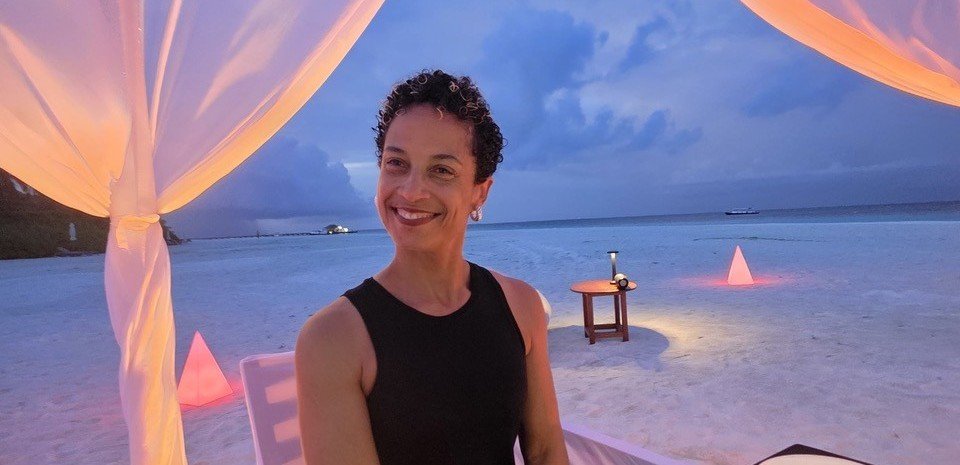
As I kick of season 2 of My In the Cut Interviews with phenomenal leaders, I’m happy to welcome Tyra Mariani. Tyra, Welcome to The Cut and thank you for saying yes.
Let’s talk about how you identify. What I have found as I have matured in my leadership that I do understand how it all shows up in me. How do you identify?
I was wondering about this question because I didn’t know if you wanted the narrow or the broad and I decided to go broad. I am God’s child. I am Christian. I am the daughter of Rose and Eddie Mariani. I identify as a New Orleanian; an African American woman; a leader; a sister; a fighter; a cancer survivor; a friend; and a health enthusiast.
And that’s the start because there’s so much more of us, right?
I chose not to lead with race and gender because we get reduced to that and I am so much more than that.
Sheila: Yes, because how we choose to name and claim ourselves and live our lives is our choice.
“I choose not to lead with race and gender because we often get reduced to that.”
Living in the intersectionality of how you describe yourself, do you find moments in your head where you acknowledge, “I’m leaning on this part right now.”
I do. I think the one that is most prevalent for us is race and gender. Because you’re like, I’m the only Black person in the room. Am I going to be that one today, or not? Do I feel like fighting today, or not? I think it’s in the moment somewhere that you feel a responsibility to lean and show up. It’s what you have the energy and mood for. So, yes, I totally make choices in any given moment, day or hour for that.
Sheila: For some there is privilege in that. Some people never have to think about that. And when we as Black people add education and proximity to power, we find ourselves in moments of different privilege that requires us to lean.
What’s the work you do? What is the work that intrigues you the most and excites you when you get out of bed in the morning?
Helping people think about and through hard things and to find and live into their trust in all the identities they want to hold. This work spans solving big problem – from society’s most entrenched problems to business problems – to coaching individuals to live whole, healthy, authentic lives. I used to call it helping people to turn the lights on – that moment or period when they realize a thing for themselves.
Sheila: What I hear from you in terms of the lights turning on is such a visual moment where you see that they got it and it’s not because you forced it. You don’t have that type of instinct. You have a way of listening and asking important questions that help others become clearer about the situation they are facing.
What is it that makes you good at solving big problems and turning the lights on for folx?
I would just call that a spiritual gift, somewhere between nature and nurture. It’s been a journey of embracing and leading with head and heart. I’ve always admired people who attract people because they lead with the head—meaning they’re so smart in their ability to quote data and bring ideas to fruition, for example. I long wanted to emulate that – yes, failing to recognize the gifts I also had. And then I realized that my heart, if you will, is part of my superpower, part of my essence. So, I thought about how to combine those things to do the work that I do. If you’re in touch with both, it makes it a bit easier.
Sheila: At first, I was more head leaning and as I matured as a leader, I felt the heart part grow. But the head part was always there.
Yes, we get rewarded for the “head” – our brains and intelligence. Societally we’re taught it’s all about the head. Particularly in a professional setting, it’s all about the head. It has been, and continues to be, a journey to recognize that it can be inclusive of and doesn’t have to be exclusive to.
When did you first know you were a leader? When did the leadership bug find you or you made it so?
At first, I thought about playing teacher when I would accompany my Mom to work on the weekends. She was an insurance claims supervisor for a health insurance company. I would go into the supply room, pull out all the stuff and go into my imaginary class and teach!
I actually think that part of it came when I was at Chicago Public Schools, known as CPS. I had transitioned from the private sector into CPS and I found there were ways for me to contribute and help others without having the knowledge and relationships in the district.
One example that comes to mind is when the district Managing Directors were struggling with how to leverage software. I ended up organizing tutorials as part of our gatherings to help them gain and build skills. It was the first time I realized that leadership didn’t have to be formal and bestowed upon you. I recognized that I had things to contribute and other people were interested and followed. There were several opportunities at CPS to lead in that way and they eventually led to formal leadership roles. But that was probably one of the first times I recognized that there was a “thing” here.

Did you have people who you admired at that time of your career who were leaders? Not necessarily that you would emulate them but recognized that how they led was a good way of getting things done.
My first job was at McKinsey & Company as a management consultant and I was working with a colleague who was at a managerial level. We had a side project of working on selling an idea that the firm should invest in. This person had a brilliant idea about the size of and opportunity within the ethnic market, starting with the African American market. We went through the firm’s competition and we didn’t win but that didn’t stop him.
He had enough belief and gumption to walk away from the firm and bring other leaders and highly talented colleagues with him to start a new business. It took boldness to leave the comfort, security, money and important work; and courage to launch out on one’s own and say, “I really think there’s an opportunity here. I believe in myself. I believe I can attract people.” .
I can’t say that I try to emulate that but I remember the admiration I had for the person’s thinking, conviction, inspiration, boldness… all the things. I think that was one of the earliest signs of “wow”. After that I started paying attention to other leaders and thinking about what I wanted to emulate about them. I would eventually give that up as I realized that was not the goal.
I felt like I was developing a toolkit of leadership. It was like, oh, I need to get this or I need to follow or shadow a little bit longer before I go do the thing. And somewhere in there I learned that were all just making this up. We have important experiences, knowledge and skills to be applied, but there is an element of “make it up and do it” that I had to realize to come into my own.
Did you go with him to his new company?
I did. I was actually starting business school and I ended up joining the team for a summer. I did follow because I was one of the key people on the project with him and knew all about it. If he was willing to try it, and I had so much respect for him, then certainly I would and could, too.
Sheila: That’s a whole thing. I admire you. I saw more wrong done in leadership in my early days than done well. I’d have to think long and hard to see if there was anyone who I would follow to a new opportunity!
“I try to play the angel’s advocate by asking what might I be missing that made this leadership situation harder than it looked?”
What surprises you about leadership?
I’m going to change the tense of the question to what surprised me about leadership which holds to something I literally watched over the weekend and thought, there’s that youthful ignorance and what you believe!
I think what surprised me is how incredibly hard it was. It’s also where the youthful ignorance comes in because you look at it, and if you have not done it before, it feels and looks so much simpler than it actually is. I often say that I hope we use VR to help each other step into other’s experiences. It’s really easy to look at a leader when they make a big, or not so big, mistake and name how they should have done XYZ without full insight into the complexity and factors that are not so evident that inform how one leads and acts.
When I want to understand something, I wonder, “what were they thinking?”, and try to play the angel’s advocate by asking what might I be missing that made this harder than it looked.
Sheila: that’s very interesting to think of VR as a way to do that. You’re an educator so learning is close to you. So how do you create that learning moment?
Right. Imagination isn’t sufficient. I think there’s something to simulation, or doing it, and obviously not all things can be done without serious consequence or risk so simulation is one way to act without consequences to real people. While I can understand and heed the advice of others, there’s nothing like doing to really learn a lesson and I imaging that’s true for all of humanity!
Let’s go back to identity and leadership. As you described yourself at the beginning, how does that inform you?
I feel that I am able to see people more and I am nuanced in my thinking and actions.
Let me give you an example. I am a first-generation college graduate so I know what it means to show up in a corporate workplace and not fully understand what to do or how to dress. It was in college where I’d learn the nuances of how I should dress professionally and the importance of doing so. So, when I encounter individuals who are not dressed well for the workplace, I now have the awareness that maybe that person did not have anyone to show them. So that aspect of my identity has allowed me to understand what the fuller picture is or what that other set of circumstances might be that I’m not thinking about.
Also, when I say I see people more, it’s because I have been or could be a minority in some of the ways that I’ve described. I know what it feels like. I know what it looks like. I know what those actions are that made me feel a certain way.
For example, I was a chief of staff at one point in my career and was doing the work at the same level, if not a deeper level – because I was responsible for such – as my principal. I remember he was asked to do a speaking engagement. Because he couldn’t do it, he said that I should. The inviting institution declined the offer for me to substitute. The narrative I came up with was that because I wasn’t the executive director, I was the chief of staff, they weren’t interested. So, I know what it feels like to not be enough, to be diminished.
All of these experiences have shaped my identities and made me a stronger leader. I try to be more aware and present in all of those nuances and factors.
Sheila: I wrote down that the struggle makes you a stronger leader. This situation of being heart-centered, inclusive, aware, instinctive, born of who you are, and simultaneously being the person who is not seen, heard or respected – yet you have to deliver. Describe that tension.
Look, we wouldn’t be able to get out of bed as women, and Black women, if we were overwhelmed by that reality. Part of it is choosing to use that energy for good. Some pieces are unfortunately the state of the world and you have to look for spaces for care and acknowledgement while knowing you still have to deliver. It’s part of why many in our country are feeling threatened because we have been able to do what we have in spite of all of the obstacles. It's necessary to acknowledge, respond and care while also recognizing that you have to deliver. The responsibility that comes with this is to recognize that you have an opportunity to do and be different.
Sheila: When you say that you didn’t have many people to admire and respect in leadership, I realize the same for me. That led me to try to be better – to be a person who I would admire and respect as a leader. I always remember that I have opportunities to show up differently.
“You have an opportunity to do and be different.”
A learning moment. Whether it was an affirmation or rejection. Describe a learning moment and why it resonates for you.
It was a little bit of an “aha” just now because I didn’t think of an affirmative learning moment!
The one that’s coming up for me is my time in Seattle where I was trying to do equity work. I tried to get us on the same page about what equity is, and if we say it’s at the center, how do we establish common language and a shared definition? I knew the work itself was going to be hard but I didn’t think it was beyond the proximal zone of development for people and it ended up being that. Folx had to look in the mirror in ways that they were not prepared for and that I did not anticipate. It ended up costing me significantly.
If I were to do it again, I would stay in a safer zone that was not so challenging to individual’s identities. That moment was about recognizing my own limits which is hard to predict on the front end. But certainly, in the future to think about that there is not always a right or wrong. And similar to what I was describing before, is there a certain set of factors that need to be weighed to recognize what folx are really ready for and maybe be even more conservative to test out my hypothesis.
Sheila: I so appreciate how you described it, Tyra, in thinking about how your work is to help folx turn the light on. You were on the path to your north star of bringing awareness or shining a light in darker places. And what we just talked about, that struggle of wanting to, and knowing you have the ability, to help get somebody to that. Yet, the human you are is part of the resistance and every day you get up and say “I can do this” and then recognize, at what cost.
What is your leadership superpower?
Being measured and steady. It’s hard to get me to go into high, at least on the outside. In fact, the more illuminated or excited other people can be, the calmer or steadier I can get. I know in times of difficulty, that is appreciated. I’ve gotten feedback on that.
The other is developing and supporting people. It all connects to turning the light on. Somewhere between knowing that people show up in a work setting, wanting to do their best, and how you help them get there. Part of that is also realizing when they are way too far over their skis. Some of that is how you support and coach people because we are all on a journey.
Sheila: So, when the coaching and supporting isn’t working…
That’s where you’ve got to make the hard decisions. Sometimes as leaders we forget about the consequences to the rest, whatever that looks like. We feel so much compassion for a person or a group of people and you always have to think about what the situation is costing the organization in terms of what we are able to do and more. You have to make the hard decision to move them to another seat or get them off the bus. You have to make the hard call and recognize that is part of leadership.
Do you think about what will be required of you to be successful when you go into a new situation?
I do. When I take a traditional job or a client, I think about what I can contribute and what I can learn. it’s a give and take relationship. It’s like buying something. You pay an amount and you expect to get something in return.
I always ask about the thing that I’m going to get into later so my eyes are wide open. Recognizing that nothing is perfect when we are in the presence of human beings. How do I understand what I am joining, confronting, working with so I can be eyes wide open and know that’s what I want to sign up for?
Sheila: What I hear in you and know of you is that calm surety that you talked about. That whatever it is, we’ll figure it out.
When you’re suiting up and getting ready for the big things, where do you go for your juju?
What comes to mind the most is that it depends on the thing!
If I’m feeling good or really need to show up, I might play Diana Ross’ I’m Coming Out. If I’m feeling uncertain about the path, there is Eli Wilson’s You’re Path’s Already Made. It reminds me that there is alignment and to not have anxiety or fear. And, when I am overwhelmed by the current context and all the ways it has shown its head in the past, I listen to Ella’s Song by Sweet Honey in the Rock which says, “we who believe in freedom can not rest.” It gives me a focus and resolve.
Yes, it’s totally about what’s the thing in the moment and what my spirit is feeling.
What’s your life’s purpose?
I’m still figuring it out but I believe it includes finding and owning one’s truth and helping some navigate the way.
Do you have a talent you’re not using?
Writing and speaking.
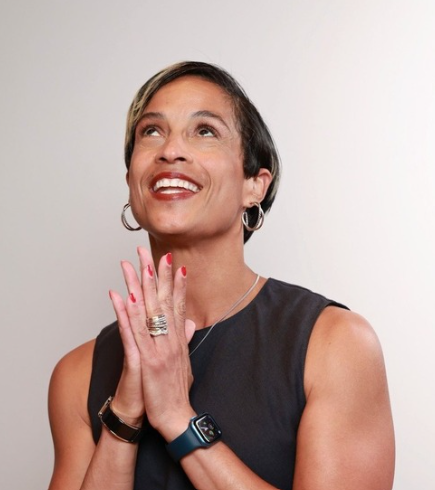
What is this 5-year chapter of your life about?
Truly embracing the journey of my shifting identity. My transformation. Holding the narrative of dancing with the Divine.
It’s a year from now, what are you celebrating?
Life. Embracing the journey and uncertainty of life. Another year of being wiser. Another year of living my best life. Health. Family. All the things that make up the blessing of this one life I’ve been given.
Sheila: Tyra, I’ll check back with you in a year. Be well, my Sister-Friend. I know there’s more to come! Thank you.